


Benimaclet, the Village Still Hidden in Modern Valencia


Valencia has long since expanded beyond its historic walls, absorbing former villages, farming settlements, and agricultural land. One of the places where this transformation is particularly interesting to observe is Benimaclet. Today, it is an urban neighbourhood with residential buildings, a university atmosphere, cafés, and lively streets. Yet its historic core still recalls a time when it was a separate settlement surrounded by country roads, irrigation channels, and fields.
Benimaclet is interesting not so much for the number of historic monuments it contains as for the way traces of its former rural life have survived within the modern urban landscape. To discover them, it is worth stepping away from the main thoroughfares and exploring the neighbourhood's older streets.
From an Andalusi Settlement to an Independent Village
Benimaclet's history began long before it became part of Valencia. Its origins date back to the Andalusi period, around the 9th century. The settlement developed around an agricultural estate known as an alquería, a type of rural property characteristic of Muslim Spain, comprising residential buildings and agricultural facilities.
The name Benimaclet itself reflects its rural origins and is associated with the Berber group known as the Maklata. Its members settled north of the Turia River and made their living cultivating the land. The development of the settlement was closely linked to the irrigation system, particularly the Mestalla canal, which supplied water to the surrounding farmland.
Following the conquest of Valencia by the forces of James I in 1238, Benimaclet was mentioned in the Llibre del Repartiment, a register documenting the distribution of land and property after the Christian conquest. The settlement passed into the hands of new owners but continued to exist as a separate rural community.
Over the following centuries, Benimaclet remained a small settlement whose economy depended primarily on agriculture. Its ties with Valencia were close, but administratively and geographically it remained a separate territory: in the 18th century, the village had its own municipal government and was not incorporated into Valencia until 1871.
This annexation did not mean that the village immediately became an urban neighbourhood. The traditional rural way of life continued for decades, and fields and agricultural estates remained an important part of the local landscape.
The Square, the Church, and the Streets of Old Benimaclet
The best place to begin exploring historic Benimaclet is Plaça de Benimaclet. This square retains its role as the traditional social centre of the settlement, around which everyday life once revolved.
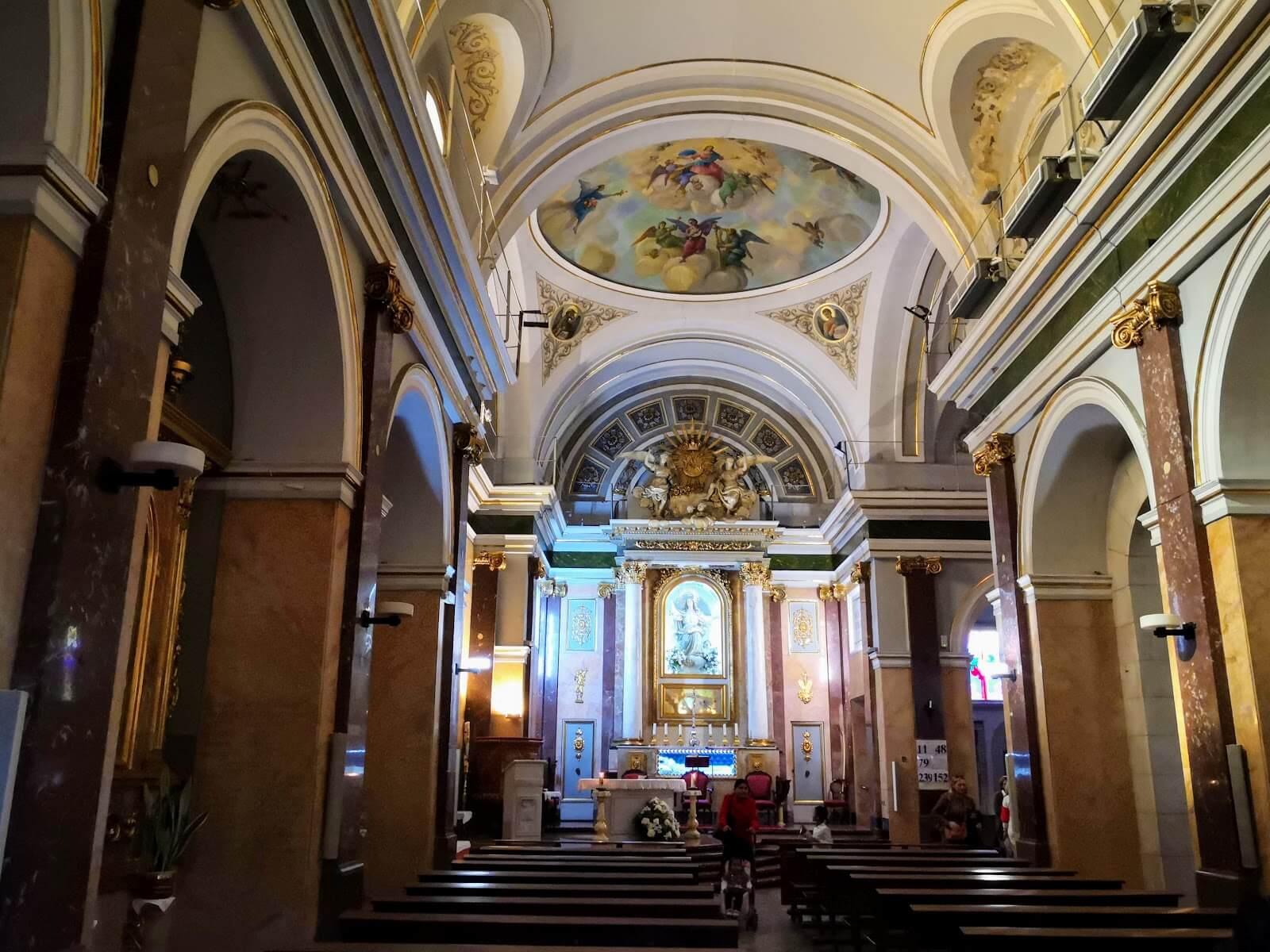
Here stands the Església Parroquial de l'Assumpció de Nostra Senyora, the Church of the Assumption of Our Lady. The parish was founded in 1594 on the site of an earlier chapel dedicated to Saints Abdón and Senén, whom local farmers regarded as protectors of the harvest. They would pray to these saints for protection against hailstorms and crop pests.
The present church building took shape mainly between the 18th and early 19th centuries. Its architecture is not a surviving example of a medieval church, but the building itself is important for understanding the settlement's history: for centuries, its bell tower served as a prominent landmark among the surrounding fields and helped identify the village within the rural landscape.
Near the church, it is worth paying attention to the old street layout. Unlike the wide avenues of newer urban districts, this area is characterised by narrow streets and low-rise houses. Their arrangement reflects the former country roads that connected the residential part of the settlement with its farmland and agricultural estates.
In particular, it is worth walking along Carrer del Baró de Sant Petrillo and the neighbouring streets. Here, you can still get a sense of the scale of the former village: small houses, buildings standing close together, and streets that were never designed to accommodate heavy car traffic.
However, this is not a preserved museum exhibit frozen in time. The historic surroundings remain part of everyday urban life, and the square continues to serve as a meeting place and venue for community events.
Valencia's expansion has significantly changed the appearance of Benimaclet, but not all its historic buildings have disappeared beneath modern developments. Some former agricultural estates have survived to this day. They now stand among residential blocks or alongside modern roads, although their architecture still recalls the area's original purpose.
One example is Alquería de la Purísima, located on Carrer de l'Assagador d'Alboraia. This 18th-century building features traditional elements of Valencian rural architecture. One of its most striking details is the ceramic panel depicting the Immaculate Conception of the Virgin Mary on its façade. It is one of the building's distinctive features, and the property is listed as an Asset of Local Cultural Interest.
The historic building has not been left without a practical purpose: following its restoration in 2012, it was converted into a day centre for older people. It is an example of how architectural heritage can be adapted to meet the neighbourhood's modern needs.
The situation is different with Alquería de la Palma, near Camí de Farinós and not far from Valencia's northern ring road. This 19th-century estate has survived amid urban infrastructure but is now in a state of neglect. Its surroundings barely resemble the former rural landscape, and the building itself has become a reminder of just how rapidly Benimaclet has changed.
These two buildings illustrate different approaches to preserving heritage: one has been given a new purpose and remains in use, while the other needs proper attention and restoration. Together, they reveal an architectural layer of the neighbourhood that is easy to overlook amid modern development.
Huerta Valenciana – The Land That Shaped the Neighbourhood
Any account of Benimaclet's rural past would be incomplete without mentioning its irrigated farmland. Huerta Valenciana is not simply a collection of fields around Valencia but a complex historic system of agriculture, roads, and irrigation channels that has developed over many centuries.
Water reached the fields through a network of acequias, or irrigation channels. Their layout determined which plots received water, how agricultural estates were organised, and where roads were built. The Mestalla canal and its associated branches played an important role in Benimaclet's agricultural life.
Such a system required the shared management of water resources. Farmers had to follow water distribution rules and keep the channels in working order. Irrigation was therefore not merely a technical matter but also an essential part of how the local community was organised.
In the 20th century, the situation began to change. Valencia's expansion, the construction of residential neighbourhoods, and the development of transport infrastructure gradually reduced the area of agricultural land. This process became particularly noticeable in the second half of the century, when the former outskirts were increasingly absorbed into the expanding urban landscape.
However, the huerta did not disappear entirely. North of Benimaclet's historic core, you can still see patches of agricultural land. They serve as a reminder that the modern neighbourhood did not emerge from nowhere but grew on territory that had supplied Valencia with food for centuries.
Community initiatives also play a particular role in preserving this heritage. One example is Huertos Urbanos de Benimaclet, a community gardening project established with the participation of a local residents' association. The project began in 2011 and offered a way to bring part of an abandoned plot of land back into agricultural use. Plants are grown here, a shared space is maintained, and connections with traditional local farming practices are preserved. This is not an attempt to recreate the old village but rather a modern way of engaging with its agricultural heritage.
How Benimaclet Became Part of Greater Valencia
Benimaclet's incorporation into Valencia in the 19th century was merely the administrative beginning of its transformation. For a long time, it retained its own character, and its residents continued to work in agriculture. Even as urban development began to approach the former village, fields remained an important part of the local landscape.
The most significant changes took place during the second half of the 20th century. Valencia's growing population, the expansion of university facilities, and the demand for new housing encouraged the development of modern residential areas. Benimaclet gradually became a fully urban neighbourhood.
At the same time, its geographical location influenced the development of its new identity. Its proximity to the Universitat de València and the Universitat Politècnica de València encouraged the growth of a student community, bringing with it new cafés and restaurants, cultural spaces, and community initiatives.
Today, Benimaclet brings together several distinct environments. The old settlement retains its compact layout and traditional square, newer residential areas reflect the city's growth, and the remaining patches of huerta recall the area's agricultural past.
This contrast is particularly noticeable on the neighbourhood's northern outskirts, where residential buildings and major roads stand alongside open plots of land.

Valencia has many places whose history remains hidden behind the familiar urban landscape. Benimaclet is one of them. It is a particularly good place to see how differently a city can evolve: former villages do not always disappear when they become part of a larger urban area. Instead, they leave behind their own features, customs, and spatial layouts. Benimaclet does not require any special occasion to visit. All it takes is a leisurely walk and a closer look at the details that are so easy to overlook in the course of everyday life.


ABOUT Torodoro
FOR BUSINESS
FIND US ON SOCIAL

