


7 Castles in Cuenca and Albacete Worth Discovering


Castles often serve as landmarks through which we can trace the history of entire regions. They were built on rocky hills, alongside trade routes, overlooking river valleys and in places where control of the land was strategically important. The provinces of Cuenca and Albacete preserve many such fortifications, linked to the Moorish period, the Reconquista, rivalries between Castilian aristocratic families and subsequent historical changes.
Some fortresses still feature imposing towers, defensive walls and inner courtyards, while others have survived centuries as ruins. Yet their history goes far beyond their military purpose. Behind their stone walls lie stories of writers, kings, noble intrigues, towns that flourished thanks to their strategic location and settlements that gradually lost their former importance.
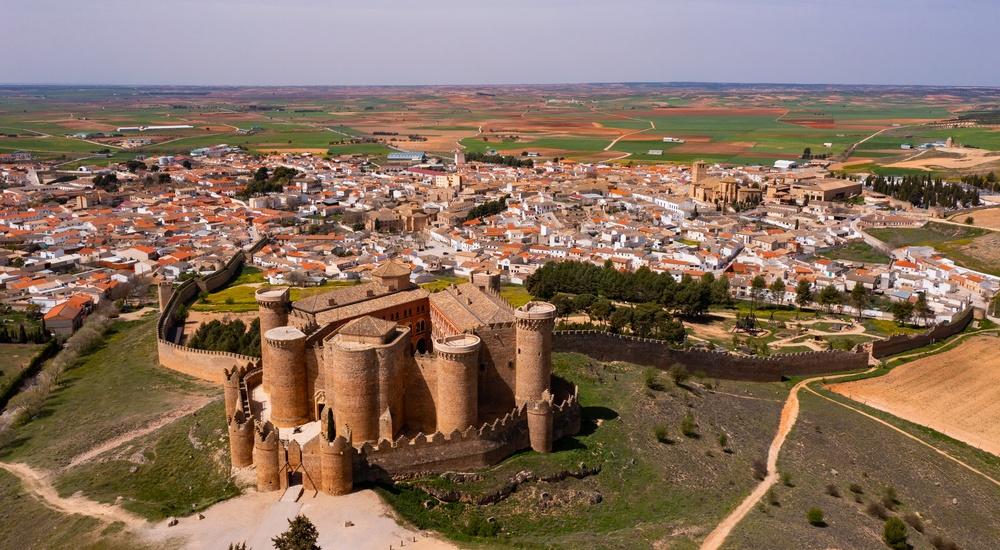
Castillo de Belmonte – the Fortress of the Marquis of Villena
Belmonte Castle, in the province of Cuenca, is one of the most remarkable 15th-century fortresses in Castilla-La Mancha. Its construction began in 1456 at the behest of Juan Pacheco, Marquis of Villena, one of the most influential political figures at the Castilian court at the time. He envisioned it not only as a defensive stronghold but also as a residence that would reflect the status and power of his family.
The castle stands out for its unusual shape: its layout resembles a hexagon, with three large towers forming its structure. Its defensive features, massive walls, loopholes and carefully chosen location were designed with military needs in mind, although the architecture also incorporates elements typical of aristocratic residences. The interior rooms, galleries and decorative details show that the aim was to create a comfortable living space rather than just a defensive structure.
Over the following centuries, the fortress went through periods of decline and restoration. It was restored in the 19th century and later became one of Spain’s best-known examples of historic architectural restoration. Today, visitors can explore its interior rooms, defensive structures and different sections of the castle, and imagine what everyday life inside the fortress was like.
Castillo de Alarcón – a Fortress on a Rocky Peninsula
Alarcón is situated on a rocky promontory surrounded by the waters of the Júcar River. The terrain is so striking that its natural barriers became part of the settlement’s defensive system. This strategic location helped the town and its fortress retain their importance for many centuries.
The castle has ancient origins, and its history is linked to the Muslim period and the Castilian conquest of the territory in the 12th century. In the centuries that followed, the fortress became an important military and political centre, passing into the hands of kings and members of influential aristocratic families. Its fortifications were modified repeatedly to adapt to new military technologies and the needs of its owners.
Today, the castle retains its massive towers, walls and characteristic defensive features. It is now used as a hotel, combining its historic atmosphere with a modern purpose.
Alarcón is interesting not only for its fortress. The medieval settlement, its narrow streets, old churches and views of the Júcar form a cohesive historic ensemble in which the castle remains a central feature of the local landscape.
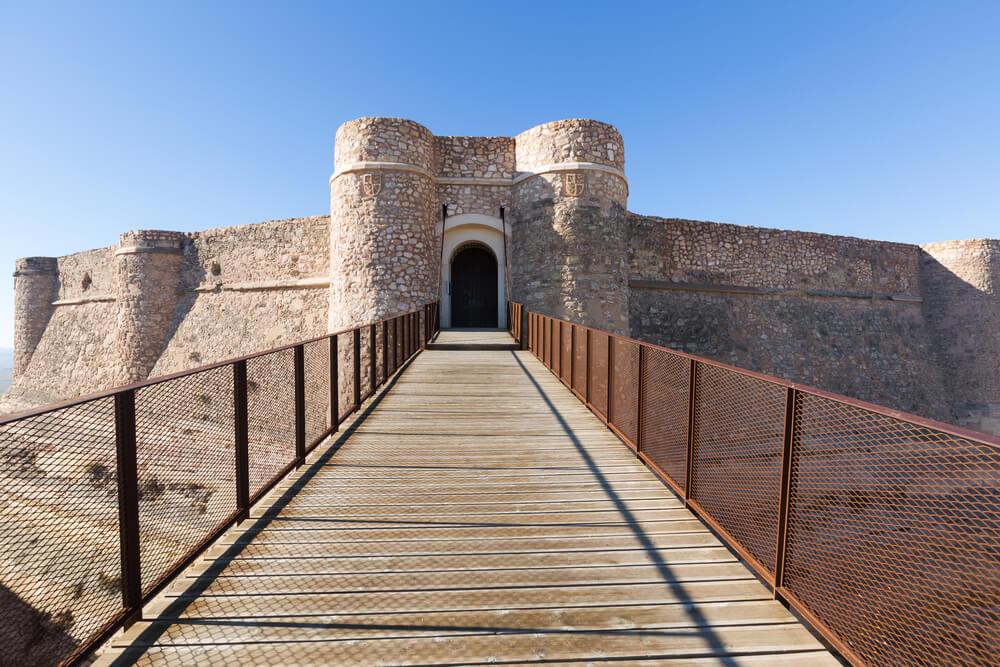
Castillo de Chinchilla de Montearagón – a Castle with a Moat Carved into the Rock
In Chinchilla de Montearagón, in the province of Albacete, the fortress stands above the town on a rocky plateau. Its silhouette is clearly visible from the surrounding area, and the castle is an important part of the settlement’s historic character.
The fortification has Arab origins and was gradually rebuilt after the Castilian conquest in the 13th century. Major changes took place in the 15th century, when the fortress became part of the political and military rivalries between influential Castilian families. Its defences were strengthened, and its structures were adapted to the needs of the time.
One of the castle’s most distinctive features is its deep moat, partly carved directly into the rock. It illustrates the scale of the engineering work that could be required to create a defensive system. The walls, towers and position of the fortress complemented the natural features of the terrain.
In later centuries, the castle was also used as a prison, which became another chapter in its history. Today, the elevated site on which the fortress stands offers an unusual vantage point over the town. The streets of Chinchilla de Montearagón, traditional houses and old squares preserve the character of a historic settlement that developed around the fortification.
Castillo de Almansa – a Fortress Rising from the Rock
Almansa Castle has a particularly striking silhouette thanks to its position on a rocky hill overlooking the town. Its history spans several eras, from a Muslim fortification to a fortress that became an important part of the Castilian defensive system.
The castle underwent major changes in the 15th century under Juan Pacheco, Marquis of Villena. It was then that it acquired many of the features that define its present-day appearance. The central tower, defensive walls and structures adapted to the contours of the rocky terrain form a complex architectural composition.
The features carved directly into the rock are particularly interesting. Some of the interior spaces and passages are integrated into the natural terrain, revealing how builders used the geological characteristics of the site to create a fortress. Its elevation, steep slopes and access routes played an important role in its defence.
Almansa is also associated with the Battle of 1707 during the War of the Spanish Succession. The battle took place near the town and was one of the key events of the conflict. The castle, long a symbol of Almansa, still dominates the town’s skyline, and its history helps us understand how important this region was in different periods.
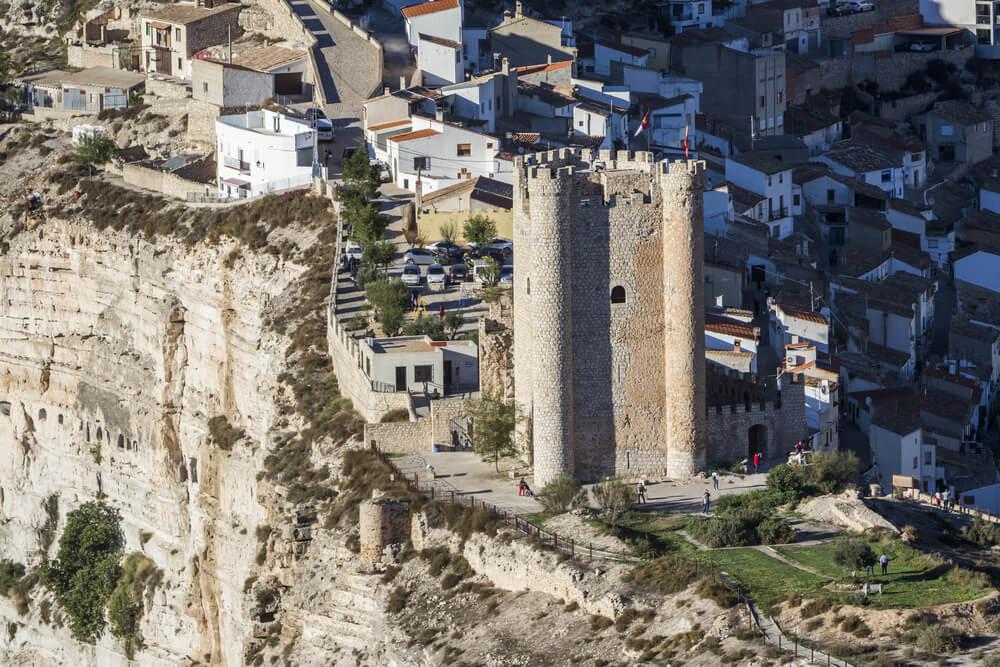
Castillo de Alcalá del Júcar – a Fortress Overlooking a River Gorge
Alcalá del Júcar lies in the valley of the Júcar River, where steep rocky slopes shape the character of the settlement. The castle occupies a high rocky outcrop above the gorge, while houses descend along the slopes, adapting to the rugged terrain.
The fortress has Arab origins. Its location allowed it to control the surrounding territory, river routes and important passageways. After the Castilian conquest in the 12th century, the castle gradually changed, and its defensive structures were adapted to new needs.
Parts of the walls, towers and central elements of the fortification have survived to this day. Although the castle is not particularly large, its location makes exploring the architecture and surrounding landscape especially interesting. The rock on which it stands naturally restricted access to the fortress, while its height provided a vantage point over the valley.
The castle offers views of the river, the old quarters and the surrounding cliffs. Here, it is particularly easy to see how local inhabitants adapted to the natural environment over the centuries, using the terrain to build homes, roads and defensive structures.
Castillo de Moya – the Ruins of a Former Fortified Town
Moya, in the province of Cuenca, is not just an isolated castle but a historic fortified settlement whose ruins stand on a hill in a mountainous area. Once, an important town stood here, surrounded by defensive walls and featuring churches, residential buildings, streets and fortifications.
After the Castilian conquest of the territory in the 13th century, Moya became a strategic point in the borderlands. Its importance grew over the following centuries, and the settlement was associated with various aristocratic families and military conflicts.
The complex includes the remains of several defensive lines, towers, gates and fragments of historic buildings. Among the ruins, it is possible to recognise the layout of the former town rather than just isolated parts of a fortress. The sheer size of the site gives an idea of how important this fortified settlement once was.
A walk through Moya takes you among stone ruins, open spaces and mountain scenery. The place retains a sense of its former urban life, although today its streets no longer lead to residential neighbourhoods or market squares, but to the remains of architecture that have survived for several centuries.
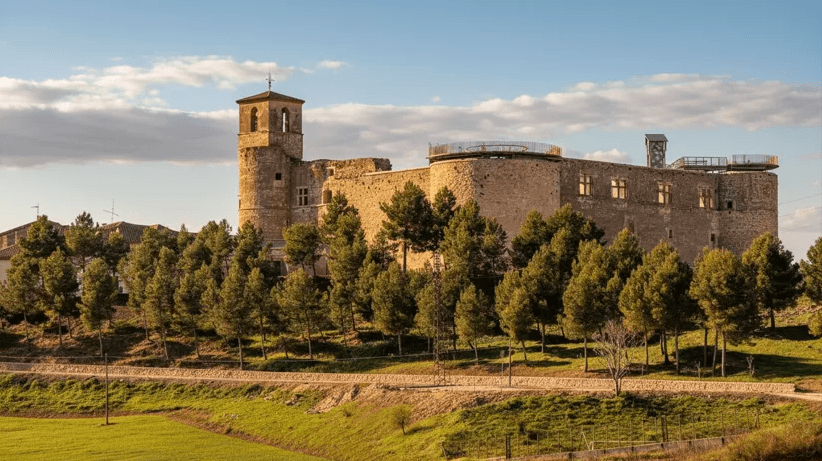
Castillo de Garcimuñoz – a Fortress Linked to Literature and Castilian History
Garcimuñoz Castle, in the province of Cuenca, has a history that brings together military architecture, medieval literature and political events in Castile. Before the present-day castle was built, a Muslim fortification known as Al-Borch-Jamal stood here. In 1182, the settlement was conquered by Christians during the reign of Alfonso VIII and subsequently became known as García Muñoz.
The castle is closely linked to the Villena family and to Infante Juan Manuel, who lived here for much of his life. He was one of the most important writers in medieval Castilian literature and the author of, among other works, El conde Lucanor. Historical sources associate his residence and literary activity with this fortress.
In the 15th century, the castle was rebuilt by order of Juan Pacheco, Marquis of Villena. The structure acquired its characteristic high walls, massive towers, defensive features and Gothic decorative details. In the centuries that followed, the fortress underwent further changes: during the reign of the Catholic Monarchs, it was partially lowered, and later the Church of San Juan Bautista was built inside it and consecrated in 1708.
The site is also associated with Jorge Manrique, a 15th-century Castilian poet. In 1479, he was mortally wounded near the castle during the siege of the fortress. This story adds another literary dimension to the place, as Manrique is known for his Coplas por la muerte de su padre, one of the most outstanding works of medieval Spanish literature.
Following restoration work carried out in 2016, the castle took on a new role as a cultural space. At the same time, the traditional layout of the settlement has been preserved within Castillo de Garcimuñoz, and the surrounding streets, old houses and historic buildings add to the experience of exploring a fortress that remained at the heart of local life for centuries.
The castles of Cuenca and Albacete preserve a history that cannot always be found in textbooks in its entirety. It is reflected in architectural details, the location of fortifications, old town streets and landscapes that once shaped the military and political fortunes of these territories. Travelling between these sites can become an opportunity to discover the small towns of Castilla-La Mancha, where historic landmarks remain part of everyday life rather than simply places to visit briefly.


ABOUT Torodoro
FOR BUSINESS
FIND US ON SOCIAL

