


Valencia’s Forgotten Gates


Today, you can walk through the streets of Valencia, moving freely from one neighbourhood to another without wondering where the city ended several centuries ago. Medieval Valencia, however, had clearly defined boundaries, protected by walls and guarded by gates through which merchants, travellers and soldiers passed. Some of these structures disappeared along with the city walls, but others have survived and continue to shape the appearance of the historic centre. They offer a way to trace Valencia’s expansion, discover where people arrived from and explore the events that left their mark on its architecture.
Torres de Serranos – The Grand Entrance to Medieval Valencia
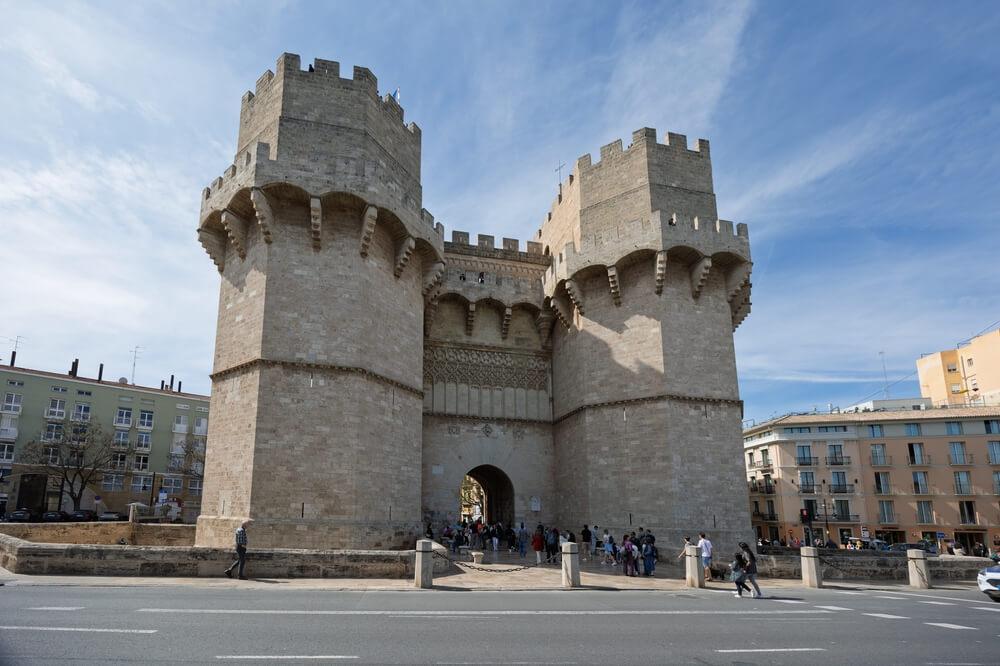
The two imposing towers of Torres de Serranos rise beside the former course of the Turia River, close to the modern-day Turia Gardens. They are hard to miss, even among the dense buildings of the historic centre. Yet they are far more than a picturesque backdrop for photographs: they are one of the most important surviving examples of medieval military architecture in the city.
Construction of the gate began in 1392 under the direction of master builder Pere Balaguer and was completed towards the end of the 14th century. At the time, Valencia was experiencing a period of economic prosperity, and its trading connections were helping the city flourish. The new fortifications were intended to protect an important entrance from the north, through which travellers arrived from Aragon and Catalonia.
The architecture of Torres de Serranos combines a defensive purpose with a monumental appearance. Two polygonal towers frame the central passage, while Gothic elements give the structure its distinctive character. The gate was designed to demonstrate not only military strength but also Valencia’s status as a city keen to assert its importance within the Crown of Aragon.
Over time, its role changed. In 1586, the complex began to be used as a prison for members of the nobility, a function it retained until 1887. Its use as a prison was one of the reasons it survived the large-scale demolition of Valencia’s city walls in the 19th century.
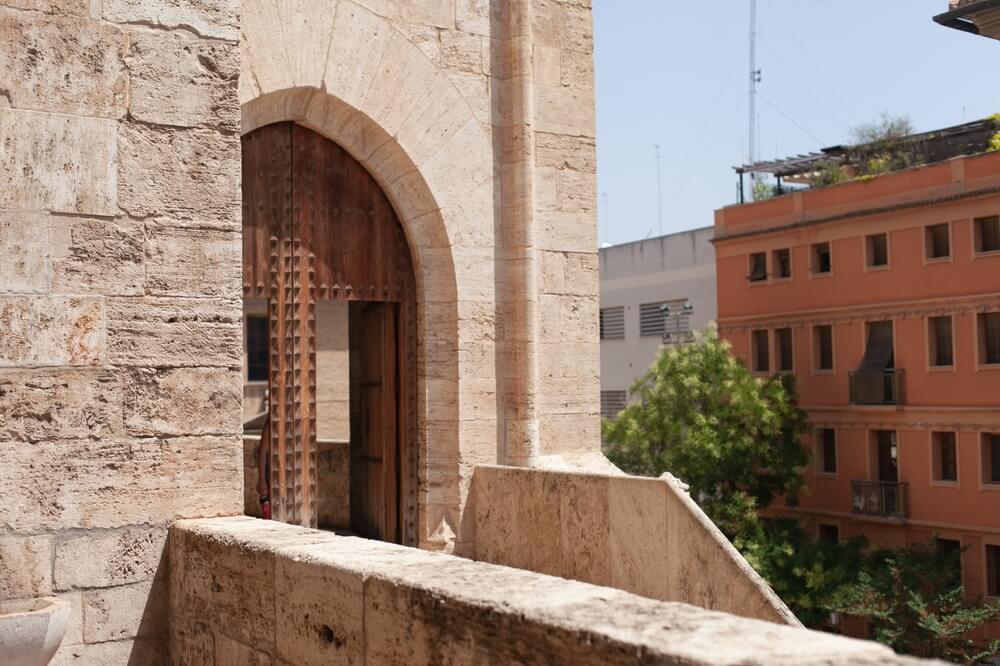
Today, Torres de Serranos is open to visitors. Climbing to the upper levels offers views of the historic centre, the green expanse of the Turia Gardens and the surrounding neighbourhoods. It is also an opportunity to examine the gate’s structure at close range and appreciate the scale of Valencia’s medieval fortifications.
The towers also have cultural significance in modern Valencia. The Crida, the ceremonial opening of the Las Fallas celebrations, takes place here in late February. The ancient gate that once controlled access to the city has thus become the place where the beginning of one of Valencia’s best-known traditions is announced.
Torres de Quart – The Gates That Remember the French Siege
While Torres de Serranos conveys the grandeur of a ceremonial city entrance, Torres de Quart has a more austere appearance. Its rounded outer towers, massive walls and restrained decoration reflect the structure’s original military purpose.
The gate was built in the 15th century, mainly between 1441 and 1460, on the site of an earlier entrance. It became part of the city’s Christian fortifications and controlled the road leading west towards Castile. The name Quart comes from the road to the nearby settlement of Quart de Poblet.
Its architectural design differs from that of Torres de Serranos. Two semicylindrical towers are joined by a central section containing an arched passage. The unusual layout reflects the course of the old road, which approached the city at an angle. This detail shows how medieval architects adapted fortifications to an existing network of routes.
In the centuries that followed, the gate was used for purposes other than defence. A women's prison was established here in the 17th century, and the building later became a military prison. These changes in use helped preserve it after the city walls were dismantled.
However, the most striking evidence of its military past remains on the outer walls. During the French siege of Valencia in 1808, as part of the Peninsular War, Torres de Quart came under fire. Marks left by cannonballs are still visible on the building's surface. Unlike many museum exhibits that tell the story of war through documents and reconstructions, this monument allows visitors to see its consequences directly in the stone.
The gate stands beside Santa Úrsula Square, close to the lively streets of the El Carmen neighbourhood. After visiting the monument, you can continue exploring the old streets, where historic buildings stand alongside residential properties, small businesses and cultural spaces.
Where Did Valencia’s City Walls Go?
Torres de Serranos and Torres de Quart are the two main surviving gates of Valencia’s late-medieval Christian city wall. In the past, however, they were just part of a much larger defensive system.
Construction of the new circuit of walls began in 1356 on the orders of King Peter IV of Aragon, known as Peter the Ceremonious. The city needed more space, as the old walls could no longer accommodate its growth. The new perimeter, approximately four kilometres long, enclosed additional neighbourhoods and religious complexes, increasing the area within the fortifications to around 142 hectares.
Twelve fortified gates of varying importance were built into the walls. Among the largest were Serranos Gate in the north, San Vicente Gate in the south, Puerta del Mar in the east and Quart Gate in the west. The main roads connecting Valencia with the surrounding territories passed through them. Smaller passages provided links between different parts of the city and its suburbs.
In the 19th century, the medieval fortifications began to be seen as an obstacle to Valencia’s further development. The city was growing and needed new streets and open spaces, while the old walls restricted construction. In 1865, a decision was made to demolish them. This opened the way for urban expansion but also resulted in the loss of a significant part of the city’s defensive heritage.
Today, the former line of the fortifications can be traced approximately by following the layout of the streets around the historic centre. The names of certain places also recall the gates and walls that have disappeared. By paying attention to the city's layout, it becomes clear that medieval Valencia has not vanished without a trace: its former boundaries continue to influence the structure of the modern city.
Portal de Valldigna – A Small Passage with a Great History
Not all of Valencia’s historic gates resemble monumental fortresses. In the El Carmen neighbourhood, among narrow streets and old buildings, you can find Portal de Valldigna, an arched passage that is easy to overlook if you do not know what you are looking for.
It was opened in 1400 in the city's older Muslim wall. Unlike the grand gates of the Christian fortified perimeter, this passage served a more local purpose, providing a connection between different parts of the city. It is a reminder that Valencia’s defensive history unfolded in several stages, with new fortifications often supplementing or replacing earlier ones.
The site gained particular significance in the late 16th century. In 1589, an image associated with the founding of the Monastery of Valldigna by King James II was placed above the arch. The image seen today is a reproduction created in the 20th century, but the gate retains its historic location and distinctive stonework.
Portal de Valldigna is worth seeking out not for grand views or the chance to climb a tower, but for its connection to everyday urban life. Here, it is easy to imagine what the passages between neighbourhoods looked like several centuries ago, when city walls shaped not only the city's defences but also the movements of its inhabitants.
It is also a convenient stop while exploring El Carmen. The surrounding area preserves old streets, historic buildings and traces of the different eras that shaped Valencia. Unlike the city's best-known landmarks, this passage does not require a lengthy visit of its own, yet it offers a way to discover the city's history through its details.
Valencia Before the Medieval Walls
The history of Valencia’s fortifications began long before Torres de Serranos and Torres de Quart were built. Founded by the Romans in 138 BC, Valencia has changed its boundaries many times, with each stage of its development leaving its own architectural traces.
The Roman city had compact fortifications. Under Muslim rule, Valencia expanded, and its defensive system gained new walls and gates. Following the Christian conquest in 1238, the city continued to grow, and by the 14th century there was a need for a new, more spacious circuit of fortifications.
Remains of earlier walls can still be seen in the El Carmen neighbourhood and near Tossal Square. Beneath the square, an exhibition space has been created where part of the Muslim city wall is on display. Other fragments and archaeological finds preserve evidence of earlier stages in Valencia’s development.
These sites help explain why the historic centre has such a complex layout. Its streets took shape over centuries, as successive defensive systems replaced one another and adapted to changing needs. Modern Valencia grew beyond the old walls, but its historic core still bears the marks of these transformations.
Valencia’s old gates can all be explored in a single walk, gradually revealing different sides of the city. A good starting point is Torres de Serranos, where you can combine a visit to medieval architecture with a stroll through the Turia Gardens. From there, head towards Torres de Quart, looking out for the marks left by the French siege on the walls, before venturing into the narrow streets of El Carmen to find Portal de Valldigna.
There is no need for a car, as all three landmarks are located in Valencia’s historic centre and can be reached on foot. However, access to the towers may depend on opening hours and weather conditions, so it is worth checking the latest information before your visit.


ABOUT Torodoro
FOR BUSINESS
FIND US ON SOCIAL
AVAILABLE LANGUAGES

